

Virgin field. Untouched. Scientist’s dream. History is speckled with such stories. You may have come upon such a field in your own career. It’s very exciting. Gets the blood pumping. So many opportunities for research, publishing, and getting your name associated with a new theory, equation, or dimensionless number . Leonard Euler experienced this dream.
Leonhard Euler (1707-1783) – Right person, right place, right time
Read Euler, read Euler, he is the master of us all. – Laplace [1]
As a child prodigy in Switzerland, the most famous and gifted student to the famed mathematician Johann Bernoulli, and collaborator with Johann’s son Daniel, Leonard Euler was well prepared to absorb the writings of the leading mathematicians and physicists and seize the opportunity to unite those two worlds. He was the right person, in the right place, at the right time. Newton’s Principia and Leibniz’s calculus, more user-friendly than Newton’s, had developed in parallel and sat waiting to be brought together. It was Euler who did this. Today, thanks to Euler, we practice Newton’s physics using Leibniz’s calculus.
The power of sitting at the interface
Euler’s seat at the interface between physics and calculus enabled him to simultaneously consider both, thus enabling one of the most remarkable parallel developments of two separate fields in history. Breakthroughs in one led to breakthroughs in the other. Euler was playing on a wide-open field that no one had yet touched.
Euler brought a sharp mind and cold heart to the task of mathematizing physics. He used a machete to cut through the jungle of ideas and thoughts and speculations. He removed the mysterious forces, the hand-waving explanations, and founded a solid and clear structure on which to build the future. Incorporated into his work was his guiding principle, “where a change is, there must be a cause,” reflecting his deep belief in the fact that something must be conserved.
Very humbling to learn this!
Euler published over 500 books and papers during his lifetime and about 300 more after his death, as others brought his unfinished manuscripts to light. His prolific nature continued to his end. Despite the onset of blindness in 1766, he worked with scribes and a phenomenal memory to continue publishing at an astounding rate.
Going Deep: How Euler made Newton understandable
Newton’s Principia held the answer to many problems except itself. Many simply could not comprehend the value of this book, which hindered its acceptance, especially on the European continent. At root was the fact that while Newton used his calculus to discover his Laws of Motion and Universal Gravitation, he didn’t explicitly include its use in the Principia, instead favoring the use of geometric analysis.
Euler took Newton’s family of ideas and re-wrote them into the language of calculus, thus making it much easier for others to understand and appreciate Newton’s accomplishments. One significant example of this concerned Newton’s 2nd Law. Euler was the one who analytically formalized the 2nd law into the equation we know today, F = d(mv)/dt = ma. Go back and re-read Newton’s 2nd Law as he wrote it, “A change in motion is proportional to the motive force impressed and takes place along the straight line in which that force is impressed.” This was a proportionality based on motion and not mass. Mass had been hidden in Newton’s celestial work simply because the fall of bodies in gravitational fields does not depend on mass. Euler was the one who wrote the equation in terms of differential calculus and explicitly included mass.
He translated, clarified, compared, and built on the philosophies of not only Newton and Leibniz, but also of Bernoulli, Huygens, and Descartes. He endorsed Newton’s “force” as an external cause of change. He used the continuity of calculus to make mechanics continuous, an approach that lasted until Planck’s discovery of the quantum forced a revision. He developed the concept of state and a change of state, concepts we continue to use to this day in thermodynamics, and proposed that all changes in state result from the action of an outside force.
Euler, and separately Daniel Bernoulli, used Newton’s 2nd Law to show that the integration of force over distance is quantified by the change in kinetic energy. Why was this important? Because this integration was the first demonstration of the theoretical connection between Newton’s Laws of Motion and Leibniz’s vis viva. Recall that Newton never directly addressed kinetic energy in the Principia simply because it wasn’t needed. He developed his laws primarily to explain planetary motion, and for this, momentum proved totally sufficient and kinetic energy wasn’t needed. From a larger perspective, Newton simply didn’t need to address the concept of energy.
Euler broke the logjam
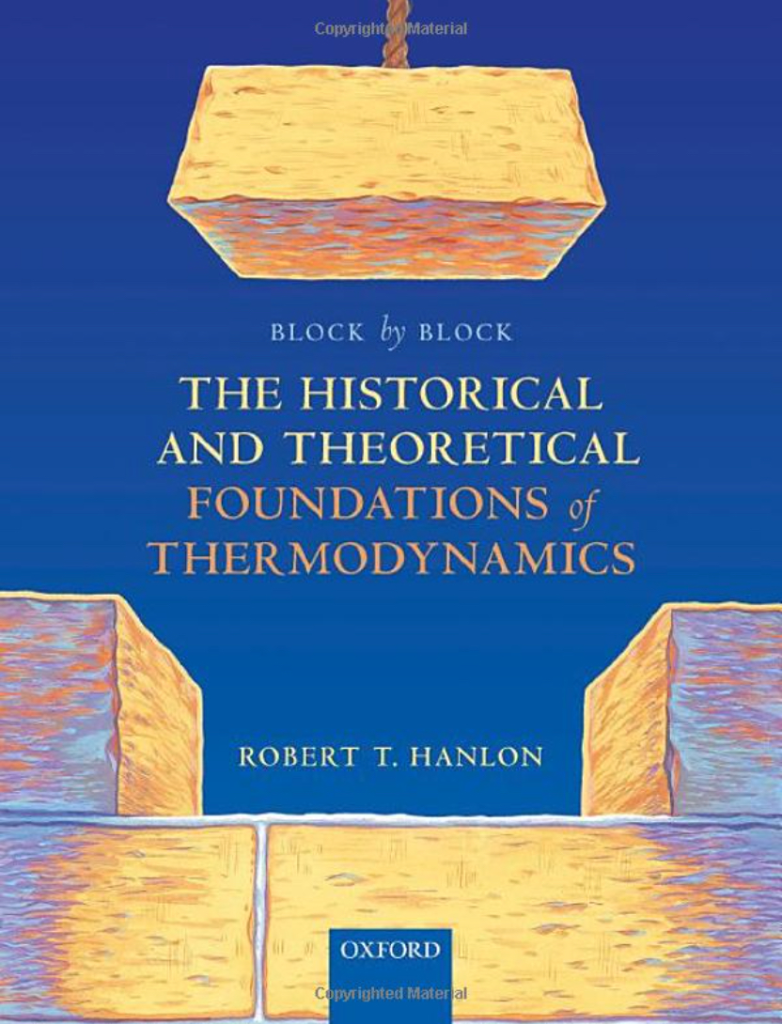
Euler helped break the logjam created when Newton’s and Leibniz’s respective works met each other in the early 18th century. He brought these two different paths together and so created the bridge to the 19th century’s completion of the conservation of energy. Explore more, especially including the contributions of the Bernoulli family, in Chapter 11 of my book, Block by Block – The Historical and Theoretical Foundations of Thermodynamics.
END
[1] Laplace quote cited in Dunham, William. 1999. Euler: The Master of Us All. MAA. p. xiii.


Leave a Reply