The deepest understanding of thermodynamics comes, of course, from understanding the actual machinery underneath – Richard Feynman [1]
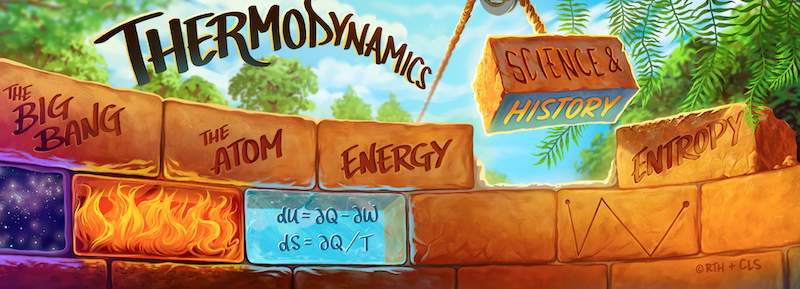
I have begun work on my second book in which I intend to connect the micro-world of moving and interacting atoms to the macro-world of thermodynamic phenomena and the classical equations used to describe them. This book will be created here, on-line, and is meant to provide content to those who want a better understanding of thermodynamics and additionally to those in the academic world seeking to create an improved syllabus. I will publish as I create and modify along the way as needed. If this journey interests you, I invite you to join me and, more importantly, help me. This is naturally a work in progress. I denote completed sections with “done.”
Table of Contents
Section 1 – Atomic Theory
Thermodynamics describes the macroscopic behavior of matter at the scale we can measure. But that behavior originates at a scale we cannot see — the scale of atoms. This section introduces the cast of characters: what atoms are, what forces act between them, and how their constant motion and interaction give rise to the macroscopic world thermodynamics describes. Everything that follows builds on this foundation.
Chapter 2 – The movement of atoms
Section 2 – Conservation of Mass and Energy
Atoms move and interact, but they don’t disappear — and neither does the energy they carry. This section establishes the two great conservation laws that govern all of thermodynamics: mass is conserved and energy is conserved. Together they produce the most powerful everyday tool in engineering and science — the mass and energy balance. It is these laws that tell you when a process doesn’t add up.
Chapter 3 – Energy, mass, and the First Law of Thermodynamics
Chapter 4 – The mass and energy balance (w/ stories from the field)
Section 3 – Law of Large Numbers
Conservation tells us what is possible. It does not tell us what actually happens. A gas could, in principle, spontaneously crowd into one corner of its container — energy would still be conserved. But it never does. This section explains why: nature moves toward its most probable state. When atoms are present in vast numbers, probability becomes a law, and that law is the Second Law of Thermodynamics. This section introduces entropy, the Boltzmann distribution, and the statistical foundation on which all of classical thermodynamics rests.
Chapter 5 – Entropy and the Second Law of Thermodynamics
Chapter 6 – The Boltzmann energy distribution – illustrated
Chapter 7 – Micro-to-Macro: setting the stage
Section 4 – The Physical Meaning of Thermodynamic Properties
Classical thermodynamics is built on a set of properties — temperature, pressure, energy, entropy, enthalpy, Gibbs energy, chemical potential — each defined mathematically and connected to the others by exact equations. But what do these properties actually mean at the atomic level? What is entropy, physically? What does Gibbs energy represent? Why does enthalpy exist at all? This section answers those questions, one property at a time, using the atomic foundation built in Sections 1 through 3. It is the core of this book.
Chapter 10 – Internal energy (U)
Chapter 13 – Calorimetry: Heat of reaction (ΔHrxn)
Chapter 14 – Gibbs energy (G) and Helmholtz energy (A)
Chapter 15 – The physical meaning of TΔS
Chapter 16 – Chemical potential (µ)
Chapter 17 – Thermodynamic properties summary
Section 5 – Gases, ideal and non-ideal (to be continued)
With the properties defined and their physical meanings established, it is time to put them to work. The ideal gas is where the atomic picture and the thermodynamic framework come together for the first time into a single exact result — one of the most powerful and most used results in all of science. From there, the section extends to real gases, where intermolecular forces reassert themselves and the simplicity of the ideal case gives way to richer and more complex behavior.
Chapter 19 – Molecular transport: diffusion, viscosity, thermal conductivity (work in progress)
References
[1] Feynman, Richard Phillips, Robert B. Leighton, Matthew L. Sands, and Richard Phillips Feynman. 1989a. The Feynman Lectures on Physics. Volume I. Mainly Mechanics, Radiation, and Heat. Vol. 1. The Feynman Lectures on Physics 1. Redwood City, Calif.: Addison-Wesley, p. 39-2.
Last updated: October 9, 2026