

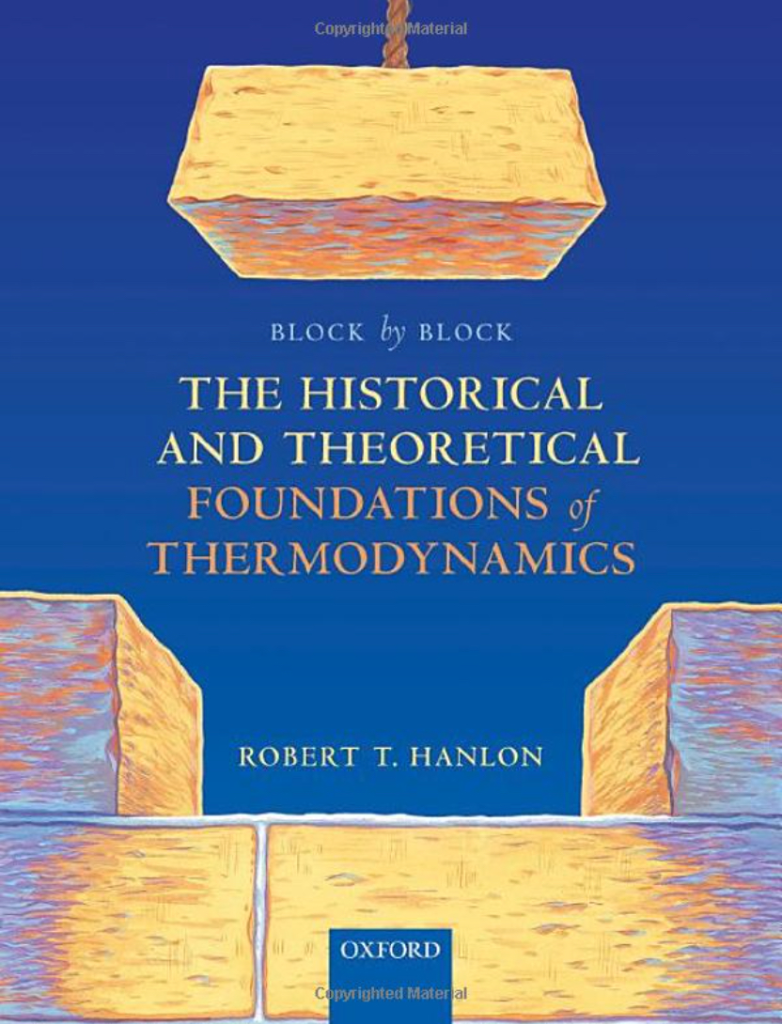
The following is an excerpt from the final chapter of my book, Block by Block – The Historical and Theoretical Foundations of Thermodynamics, in which I took a step back to share a few insights and observations I unexpectedly gathered along the way.
Happy the man, who, studying nature’s laws,
Thro’ known effects can trace the secret cause.
Virgil
My journey over the past many years in writing this book has naturally left me with a greater understanding of how and why thermodynamics came to be what it now is. I very much enjoyed this journey, and especially the more challenging parts of it, as the struggle to understand the depths of both the science and history eventually gave way to the rewarding moment of understanding cause.
* * * *
Thermodynamics does not live solely in the textbook. It lives in the worlds of heat and work. It lives in the worlds of machines, chemistry, biology, power generation, radiation, and more.
In the end, thermodynamics provides the means by which we can answer a critical question. Is what I’m doing worth the effort? While sources of energy are all around us—sunshine, waterfall, buried coal—money is required to corral these sources for productive use. You have to build the solar cells to generate electricity from the sun and the turbines to generate electricity from the falling water. The high cost of mining coal was one of Carnot’s key motivators as he contemplated how to get more energy from a steam engine for a given bushel of coal. The concepts of maximum work, minimum work, and energy efficiency and their respective impacts on capital costs and operating expenses lie at the heart of many economic evaluations involving return on investment. As the grandfather of thermodynamics, Carnot was the first to start bringing forth the theory needed to address such issues. Gibbs completed the task with his use of state properties. Here’s the starting point, there’s the end point, what will it take to get from here to there? Is it worth it? Is it even possible?
* * *
In approaching the use of thermodynamics to guide progress, the more we understand the physics behind the foundations, the better able we’ll be able to creatively and powerfully approach and solve the problems encountered. While today’s computers can handle much of the mathematics involved, identifying the physical essence of the problem will still depend on the person. To bring this book to a fitting end, a quote I introduced in Chapter 3 bears repeating here:
All things are made of atoms – little particles that move around in perpetual motion, attracting each other when they are a little distance apart, but repelling upon being squeezed into one another. In that one sentence, you will see, there is an enormous amount of information about the world, if just a little imagination and thinking are applied. – Richard Feynman [1]
THE END
[1] (Feynman et al., 1989a) Volume I, p. 1-2.


Leave a Reply