

Antoine Lavoisier
Do you want to generate an engaging discussion amongst thermodynamics historians? Play the “what if they had lived?” game, starting with Antoine Lavoisier (1743-1794). Through his meticulous work in the laboratory he discovered the conservation of mass, provided understanding of respiration as the reaction of oxygen and carbon to yield carbon dioxide and heat, and laid the foundation of modern chemistry as manifested by his replacement of the Ancient’s 4 elements (fire, earth, air, water) with 33 “simple substances,” of which 23 would remain as correctly identified true elements and the remaining 10 would later be identified as compounds. Truly remarkable accomplishments. And more accomplishments would have likely been generated had he lived past 50. Alas, it wasn’t meant to be. On May 8, 1794, Lavoisier was sent to the guillotine, a victim of The French Revolution Reign of Terror because of his work as a tax collector. As his assistant Joseph-Louis Lagrange commented, “It took but a moment to make this head fall, but even a hundred years may not be enough to produce a like on.” [1]
Sadi Carnot
The game could continue with Sadi Carnot. Arguably the grandfather of thermodynamics, Carnot conducted the first theoretical analysis of the steam engine and attempted to quantify the maximum amount of work that could be generated from a given amount of heat. His 1824 masterpiece was a beautiful diamond with a single perfect flaw, the assumption that caloric (heat) is conserved. In his posthumous personal notes he realized, with despair, his flaw. Perhaps with time he would have corrected the flaw by discovering the conservation of energy. But life intervened. Sadi Carnot died at the age of 36 during a cholera epidemic in 1832. [2]
Rudolf Clausius, James Clerk Maxwell, J. Willard Gibbs, and Ludwig Boltzmann
The game could conclude with a group of individuals, namely Rudolf Clausius (1822-1888), James Clerk Maxwell (1831-1879), J. Willard Gibbs (1839-1903), and Ludwig Boltzmann (1844-1906). Wouldn’t it have been something to have them all get together in the same conference room with a large pot of coffee, a large white board, and a large amount of time? And the opportunity was there as they lived during the same time period. Alas (again), it didn’t happen largely due to early deaths, Clausius at age 60 from an unknown disease, Maxwell at 48 from abdominal cancer, Gibbs at 64 from an acute intestinal obstruction, and Boltzmann at 62 from suicide. Who knows what they could have created, either individually or together, had they lived longer. Whatever it was, I bet would have been great.
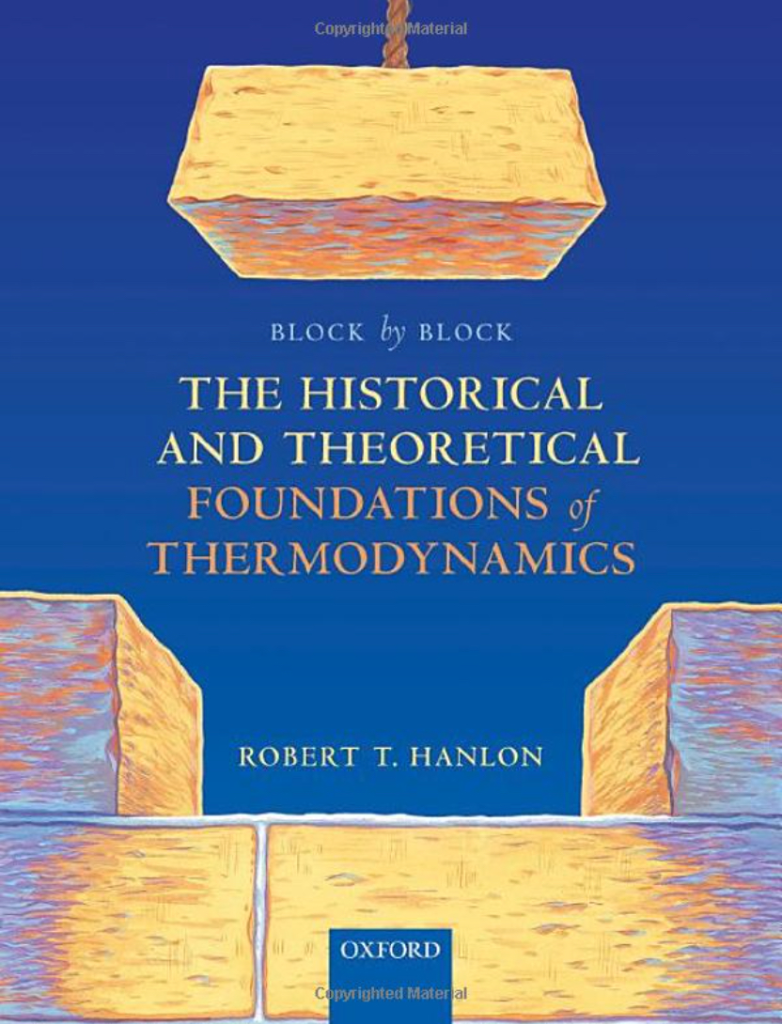
I don’t get into such “what if” games in my book Block by Block – The Historical and Theoretical Foundations of Thermodynamics but felt that doing so where would work. Thanks for listening!
References & Notes
[1] Guerlac, Henry. 2008. “Lavoisier, Antoine-Laurent.” In Complete Dictionary of Scientific Biography, 66–91. Charles Scribner’s Sons. p. 85
[2] Professor Dr. Raffaele Pisano, Université des Sciences et Technologies de Lille, provided me more context on Sadi Carnot’s death in an Oct 12, 2023 email: “We should keep in mind that Sadi Carnot developed mental illness when the cholera epidemic of 1832 hit Paris. It could be the ambiguity surrounding the cause of Sadi’s death (1832, 24th August) in Ivry–sur–Seinea death from disease, which appears to be “choléra” (Arago and Gay–Lussac 1833, LII, p. 211; Henrion 1833, p. 167). But recent research (Cfr. Gillispie and Pisano 2014, 2nd ed.; Pisano et al. 2021) strongly suggests that he developed mental illness (Cfr. Birembaut 1974) when the cholera epidemic of 1832 hit Paris.”


Leave a Reply