
I need your input on this.
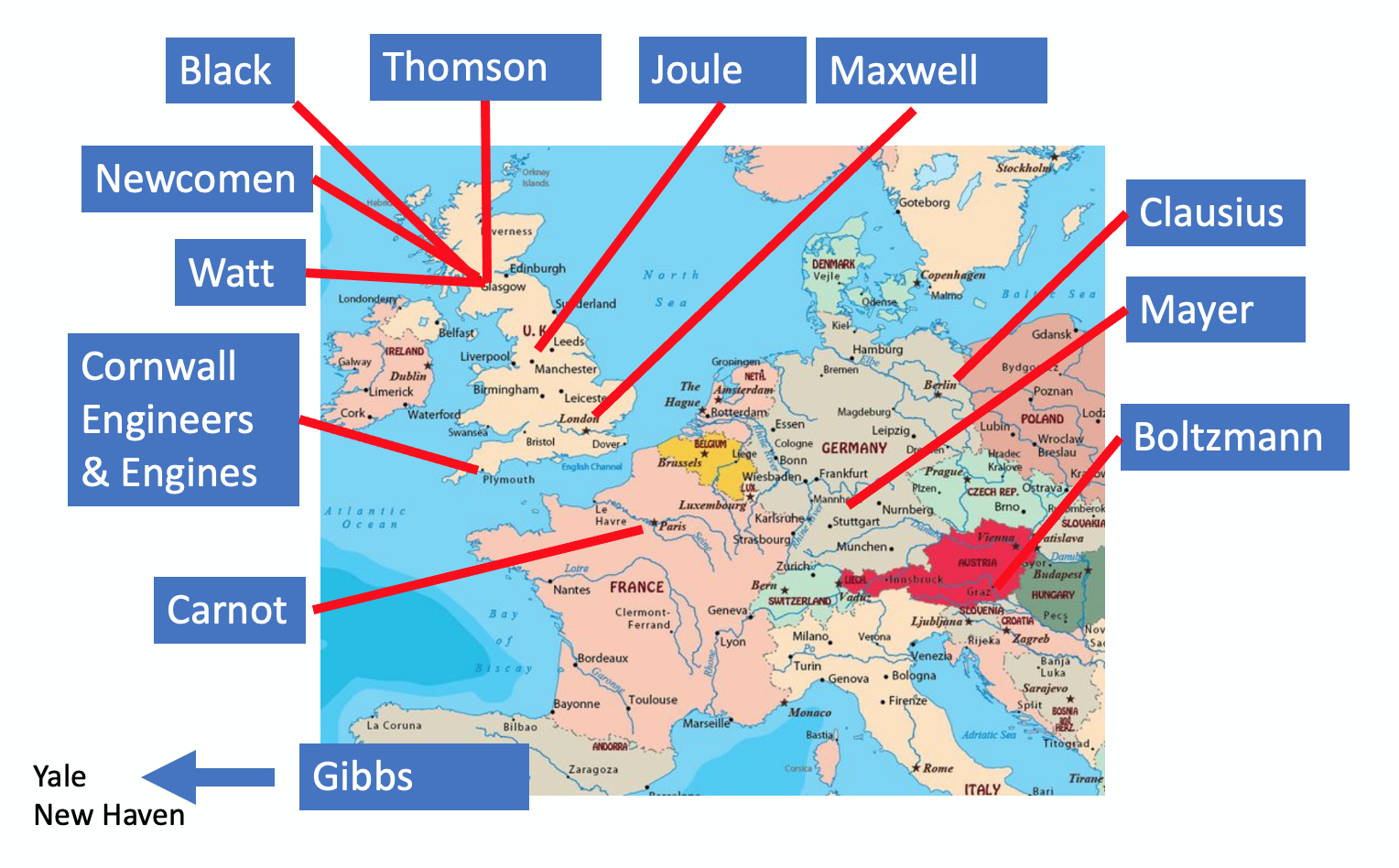
A friend of mine asked, “Bob, how about creating a European tour featuring the different locations where the founders of thermodynamics worked, including opportunities to taste the local beers?” I responded, “Great idea!” So what would that tour look like? Here’s a very rough outline based on chronological sequencing:
- Joseph Black (mid to late 1700s) – created the concept of heat capacity
- Thomas Newcomen (1712) – commercial the first atmospheric steam engine based on condensing team to create a vacuum inside a piston-in-cylinder assembly
- James Watt (1763-1800) – continually improved Newcomen’s design
- Cornish Engineers (1800-1824) – invented an improved heat engine based on pressurized steam
- Sadi Carnot (1824) – published the first theoretical analysis of a heat engine employing pressurized steam; became the grandfather of thermodynamics. A “flawed” masterpiece, per historian Robert Fox, based on the caloric theory of heat
- Rober Mayer (1845) – discovered heat-work equivalence based on the difference between ideal gas heat capacities at constant pressure and constant volume; proposed an early form of energy and its conservation
- James Joule (mid-1840s) – quantified the mechanical equivalent of heat, eliminating caloric in the process; also proposed an early form of energy and its conservation
- William Thomson (mid-1800s) – brought a deeper theoretical analysis to the works of Carnot and Joule; created the field of thermodynamics
- Rudolf Clausius (1850-1865) – reconciled Carnot and Joule to arrive at the 1st Law of Thermodynamics based on the property of energy and its conservation; later discovered the property of entropy inside Carnot’s heat engine; developed kinetic theory of gases
- J. Willard Gibbs (1873-1878) – built on Clausius’s work to complete classical thermodynamics based on the 1st and 2nd Laws of Thermodynamics
- James Clerk Maxwell (1860s-70s) – introduced statistics into thermodynamics
- Ludwig Boltzmann (late 1800s) – introduced probability into thermodynamics; founder of statistical mechanics/thermodynamics
The problem naturally is that the geography is not lined up chronologically. So I’m thinking we travel in a chronological direction as best we can while accepting the practical limitations involved.
To this end, I propose the following:
- Arrive in Paris (Carnot)
- Train/bus to Cornwall (Cornish Engineers)
- Train to Manchester (Joule)
- Train to Glasgow (Black, Newcomen, Watt, Thomson)
- Train to Cambridge (Maxwell)
- Flight to Berlin (Clausius)
- Train to Graz/Vienna (Boltzmann)
- Flight to United States (NYC) and then bus to Yale University (Gibbs)
At each stop, local historians and scientists—including physicists, physical chemists, mechanical and chemical engineers—would offer insights, complemented by guest experts on the relevant figures and concepts. Conclude each day with a visit to a local pub for dinner and local beer(s).
I’d be happy to organize this if there would be enough interest to fill a bus.
But first things first. What is the interest in tour? Would it work? Am I missing anything? Are the logistics reasonable? Obviously, flying to the United States just for Gibbs is rather impractical, so perhaps we combine Gibbs with Clausius in Berlin.
END


Leave a Reply