

[Gibbs’ “Equilibrium of Heterogeneous Substances”] is unquestionably among the greatest and most enduring monuments of the wonderful scientific activity of the nineteenth century. – H. A. Bumstead [1]
Like Sir Isaac Newton’s Principia, this work of Willard Gibbs stands out in the history of man’s intellectual progress as an imperishable monument to the power of abstract thought and logical reasoning. – Lynde Phelps Wheeler [2]
The greatest effort of sustained abstract thinking in the history of America – Lawrence Henderson on Gibbs’ 3rd paper [3]
I myself had come to the conclusion that the fault was that [my 3rd paper] was too long. I do not think that I had any sense of the value of time, of my own or others, when I wrote it. – J. Willard Gibbs [4]
Decades ago a very intelligent friend of mine (PhD, Chemical Engineering) shared, “I tried reading Gibbs and couldn’t get past the third page.” I took this as a challenge. So I read, re-read, again, again, and again and finally, after even more agains, got through most of the key parts of all three of Gibbs’s papers. Not that I understood them all, but I did understand enough to capture the main points.
Gibbs’s motivation to write #3
At the conclusion of his second paper, Gibbs highlighted the fact that up until then, all of his work had been concerned solely with a system that was comprised of a single component, or, as he worded it, “homogeneous in substance.” [5] But Gibbs was well aware that a complete theory of thermodynamics would have to account for “the motions of diffusion and chemical or molecular changes” [6] and would thus have to handle systems comprised of multiple or “heterogeneous” substances as well. Thus he devoted his third and most famous paper to doing just that as reflected in the title, Equilibrium of Heterogeneous Substances.
Others had attempted this as well
The task of addressing such a complicated situation was indeed difficult if not overwhelming. No one had yet thoroughly solved this problem as entropy had only just arrived and was central to the solution. Some had attempted the solution and achieved a certain degree of success. August Horstmann (1842-1929), for example, was the first (1873 – in October, prior to Gibbs in December) to investigate chemical equilibria based on entropy maximization, and Francois Massieu (1832-1896) had introduced (1869) thermodynamic composite properties involving entropy prior to Gibbs. [7] But Gibbs took the solution to a much higher level. While he solved this problem in his 2nd paper for a specific scenario involving a single substance and multiple phases, he sought to employ in his 3rd paper a more generalized thought-experiment scenario involving multiple species and multiple phases to create a more generalized solution. Gibbs again imagined an isolated system but this time comprised not of one component and one medium as he had in his 2nd paper but of multiple components and no medium. He then assumed this entire system to be in its equilibrium state—entropy already maximized—and asked, what does it look like?
While the elimination of the medium eliminated the convenience of assuming constant T-P during irreversible change, it did enable a more generalized approach for a system already at equilibrium and thus at fixed T-P, a significant goal of Gibbs in his third paper.
How is it possible to go from one single equation to 300 pages???
It’s rather interesting to see just how far his efforts to generalize went in this paper. With confidence, he left no stone unturned. He wasn’t intimidated in the least to cover everything. Take for example his exclusive focus on fluids in his first two papers, which offered the means to convert work done by a body into a function of pressure. He expanded the reach of his 3rd paper by including solids and surfaces for which constant pressure throughout the system did not apply. He introduced the concepts of chemical potential and the phase rule. He further expanded his reach to most all other physical phenomena of interest as well, such as osmotic pressure, capillary effects, gravity, and electrochemical cells. Gibbs’ third paper was no paper; at ~300 pages and 700 equations it was a full-blown tome that laid the groundwork for those who followed. With this single paper, he made a “clean sweep” [8] of the subject with such a “degree of perfection that in fifty years almost nothing has been added.” [9] All deduced from a single equation: dU = TdS – PdV. Amazing.
Not for the faint of heart!
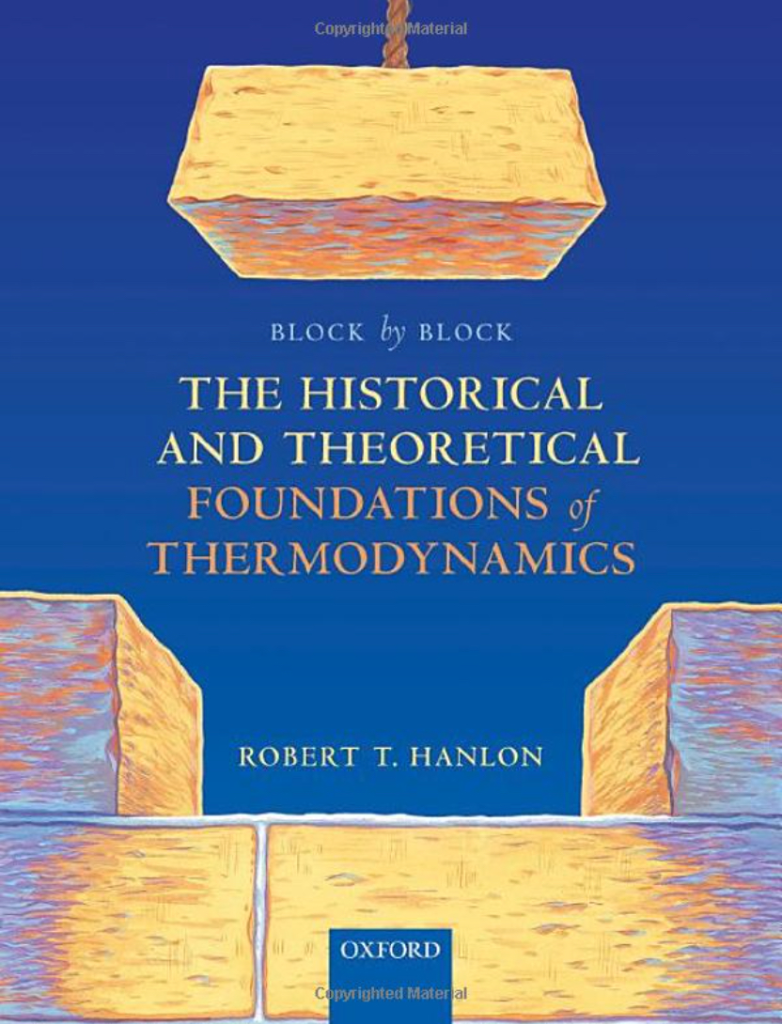
Check out my overview of Gibb’s 3rd paper in Chapter 36 of my book, Block by Block – The Historical and Theoretical Foundations of Thermodynamics, and let me know how it landed with you. And if you have time, try giving Gibbs a shot.
References
[1] Gibbs, J. Willard. 1993. The Scientific Papers of J. Willard Gibbs. Volume One Thermodynamics. Woodbridge, Conn: Ox Bow Press. p. xii. From H. A. Bumstead’s introductory biographical sketch of Gibbs.
[2] Wheeler, Lynde Phelps. 1998. Josiah Willard Gibbs: The History of a Great Mind. Woodbridge, Conn: Ox Bow Press. p. 71.
[3] Rukeyser, Muriel. 1988. Willard Gibbs. Woodbridge, Conn: Ox Bow Press. Henderson quote p. 393. Lawrence Henderson, M.D., was one of the leading biochemists of the early 20th century.
[4] Ibid. Gibbs quote, p. 264.
[5] Gibbs. p. 54.
[6] Ibid. p. 59.
[7] Crowther, J. G. 1937. Famous American Men of Science. W.W. Norton & Company, Inc. p. 271-2.
[8] Rukeyser. Larmor quote, p. 233.
[9] Ibid. Henry Adams quote, p. 232.
END


Leave a Reply