
Gibbs’ work spread throughout Europe along two separate paths. As already mentioned (here), the first started with Maxwell. It was his book that indirectly led Gibbs’s work to Helmholtz along an interesting path taken by Michael Pupin (1858-1935).[1] As a doctoral student in experimental physics at the University of Berlin under Helmholtz, Pupin was familiar with Maxwell’s Theory of Heat and thus had read of Gibbs. When Pupin realized that Helmholtz was interested in the same types of problems as Gibbs, he undertook to learn more deeply about Gibbs’s work and so obtained the original publications from the Connecticut Transactions. He “studied, studied, and studied them” until he finally understood them. He then shared what he learned with Helmholtz along with the rather brash statement, “Everything you have done and everything the physical chemists are doing today, is apparently all in Gibbs.” He even wrote in his thesis, “This whole theory of physical chemistry of today is contained in Gibbs, and the science of the physical chemistry was made in the State of Connecticut and not in Germany [as was supposed at the time].” In a testament to his sense of fairness, Helmholtz approved this. Pupin would latter go on to his own success as a famed physicist and physical chemist.
It should be noted that while Helmholtz did unknowingly cover ground already tread by Gibbs, his work was more influential to chemists. Expanding on his 1847 work on energy conservation, Helmholtz published a very influential memoir in 1882 on chemical thermodynamics. As proposed by Kragh [2], it was through this memoir and subsequent elaboration by van’t Hoff that chemists discovered thermodynamics.
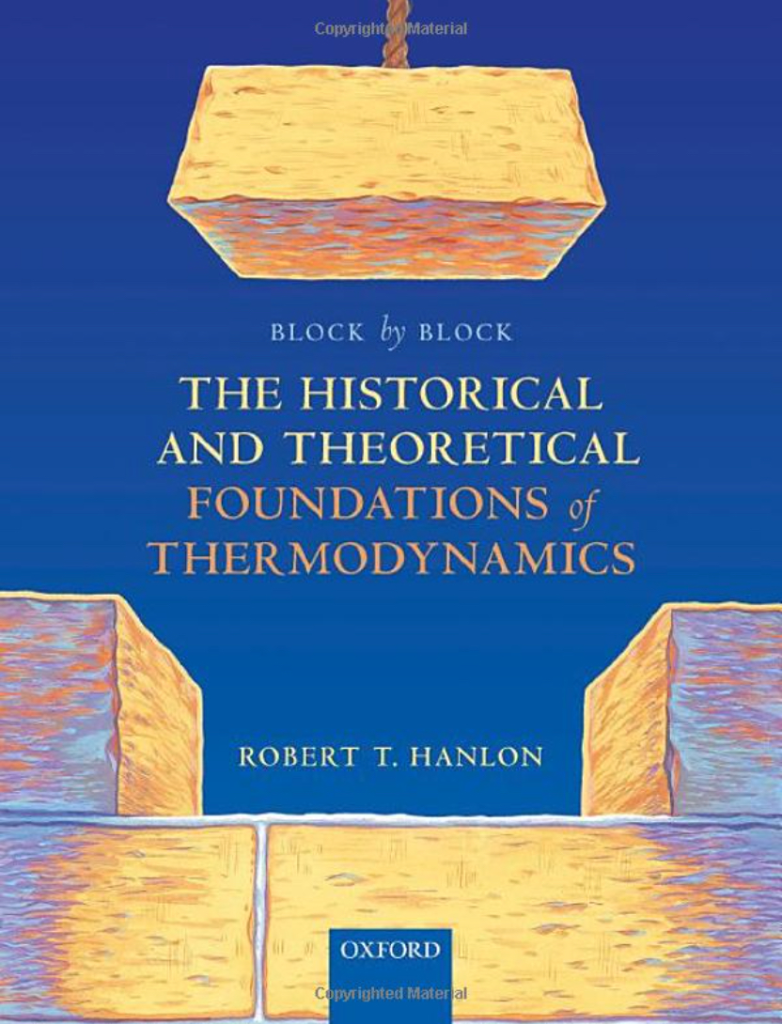
Seeking a holiday gift for an aspiring scientist?
Consider The Historical and Theoretical Foundations of Thermodynamics!
References
[1] Pupin, Michael Idvorsky. 1927. Josiah Willard Gibbs: Exercises in Celebration of the Fiftieth Anniversary of Publication of His Work on Heterogeneous Substance : With Addresses at the Graduates Club in New Haven Connecticut in June, MCMXXVII. The Graduates Club.
[2] Kragh, Helge. 1993. “Between Physics and Chemistry: Helmholtz’s Route to a Theory of Chemical Thermodynamics.” In Hermann von Helmholtz and the Foundations of Nineteenth-Century Science, edited by David Cahan, 403–31. California Studies in the History of Science 12. Berkeley: University of California Press. p. 417.
END


Leave a Reply