
Galileo
-
Standing on the Shoulders of Mentors: Sadi Carnot’s Inspired Science

It’s tempting to romanticize the image of 28-year-old Sadi Carnot, deep in thought in his candle-lit Parisian apartment, crafting the pamphlet that would pioneer thermodynamics. However, it’s crucial not to oversimplify his achievements by assuming he developed his ideas in isolation. Understanding the context is vital to appreciating the full significance of Carnot’s work. Standing… Continue reading
-
Lever + Free Fall = Kinetic Energy
The creation (discovery?) of kinetic energy was a major step toward the creation of energy itself. It’s a pretty straight-forward concept: K.E. = ½ mv2 But how kinetic energy arrived wasn’t so straight-forward. The lever: weight x change in vertical height In their study of the lever, the Ancient Greeks identified the importance of the… Continue reading
-
How did Galileo photograph parabolic motion?

Galileo, perhaps more than any other single person, was responsible for the birth of modern science – Steven Hawking [1] [Galileo] stood with one foot in the neatly ordered cosmos of medieval philosophy and with the other greeted the dawn of the mechanical universe – Richard Westfall [2] Galileo Galilei (1564-1642) was fascinated by motion. … Continue reading
-
To appreciate Galileo, you need to first understand Aristotle
While several huge ah-ha moments occurred during completion of the Big Bang and the atom puzzles, the discovery of energy and its conservation was not as clean-cut. The Big Bang was an event, the atom an object, and each was a product of nature. Each leant itself to true discovery. But energy was different. It… Continue reading
-
Why I paid $100 for a Vonnegut quote

Publisher: “Before we go to print, we just wanted to make sure you got permissions for the epigraphs in your book.” Me: “What’s an epigraph?” As I was traveling through the final stages of publishing my book, I learned that there are two approaches to using a quote. One is to embed the quote in… Continue reading
-
Newton: On whose shoulders did he stand?
No Newton, no Principia. That much is clear. But did Newton do it alone? He was naturally exposed to the ideas of such predecessors as Descartes and Galileo and such contemporaries as Leibniz and Huygens. That this collective influenced Newton is reflected in his own writing, “If I have seen further it is by standing… Continue reading
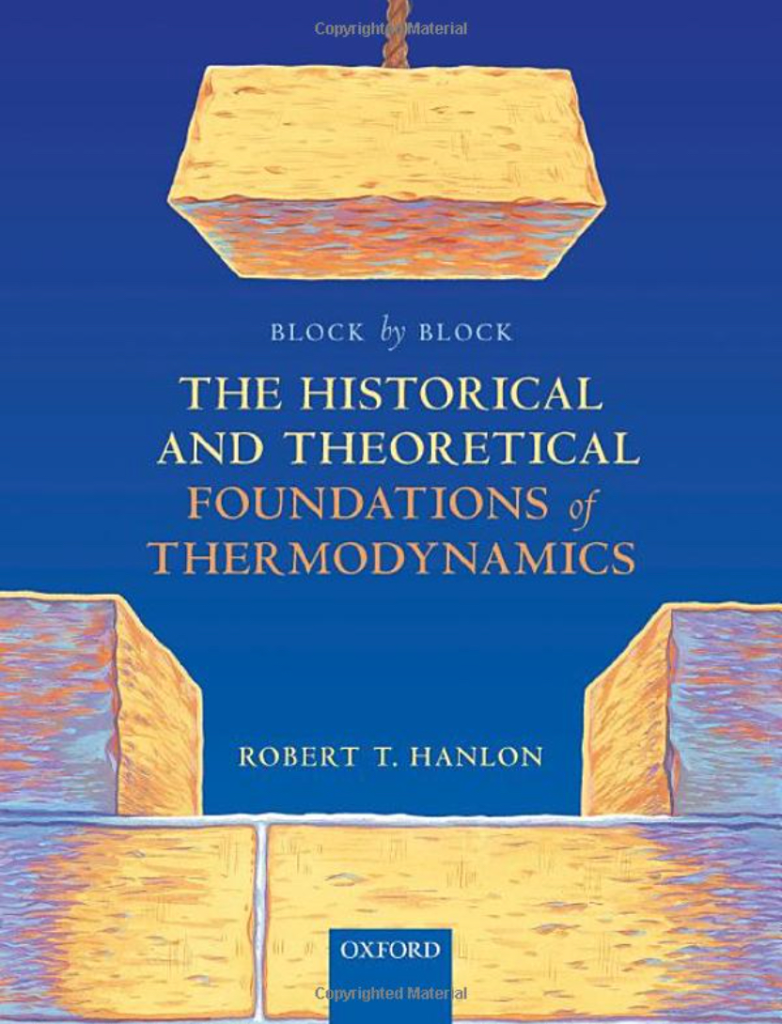
Block by Block – The Historical and Theoretical Foundations of Thermodynamics. “Hanlon has written a masterpiece.” – Mike Pauken, Senior Engineer, NASA’s Jet Propulsion Laboratory (JPL) and author of Thermodynamics for Dummies
SUBSCRIBE
About Me

Hi! I’m Bob Hanlon. After earning my Sc.D. in chemical engineering from the Massachusetts Institute of Technology and enjoying a long career in both industry and academia, I’ve returned to school, my own self-guided school, seeking to better understand the world of thermodynamics. Please join me on my journey.
You must be logged in to post a comment.