

In the years after 1850 a developed, established science with extensive theoretical structures and satisfactory experimental verification had to be re-established on a new basis; that of the axiom of the conservation of energy. This was the first time in history that such a thing had happened. It pre-dates the famous re-establishments that followed the quantum and relativity theories by something like fifty years. Thus the assertion made by popular writers of a generation ago that the calm certainty of science was not disturbed between the times of Newton and the first papers of Planck and Einstein is seen to be, in historical terms, a dangerously misleading half-truth. – D. S. L. Cardwell [1]
From the early 1850s the Glasgow professor of natural philosophy, William Thomson… and his ally in engineering science, Macquorn Rankine… began replacing an older language of mechanics with terms such as ‘actual’ and ‘potential energy’. In the same period, Rankine constructed a new ‘science of thermodynamics’ by which engineers could evaluate the imperfections of heat engines of all conceivable varieties. Within a very few years, Thomson and Rankine had been joined by like-minded scientific reformers, most notably the Scottish natural philosophers James Clerk Maxwell… and Peter Guthrie Tait. As individuals, as partners… and as an informal group with strong links to the [British science] … these ‘North British’ physicists and engineers were primarily responsible for the construction of the ‘science of energy.’ – Crosbie Smith [2]
I thought it appropriate to share the above two quotes as they really capture the story behind and significance of the arrival of thermodynamics as a new paradigm in science.
The story behind the arrival
While others such as Julius Robert Mayer, James Joule, and Rudolf Clausius contributed to the rise of this new science of energy, it was largely William Thomson and William Rankine and later P.G. Tait and James Clerk Maxwell who built the foundational structure. These men of Scotland recognized the need to develop a new structure and a new language for energy, using words and phrases that were clear, concise, and unambiguous, while eliminating those that weren’t, and so combined their common organizational talents with their respective skills in theory, experiment, and practice in a way that made the end product very powerful and lasting.
The replacement of heat with energy as a property of matter
The most critical step in this construction process was to declare a name for the overarching theme. They chose Hermann von Helmholtz’s Kraft but then had to determine how best to translate it into the English language. This proved difficult as the word itself translated into English as “force” even though Helmholtz’s use of it applied to the motion produced by force, which Leibniz called vis viva. Kraft unfortunately had different meanings associated with it, none of which matched Newton’s definition of force. A new word with a single clear meaning was needed to replace it, one that could encompass the concepts of both vis viva and work, among others.
In the end, Thomson selected the word energy.[3] From a practical standpoint, he knew that energy had long been used in everyday life and so recognized that his strategic selection of this familiar word would appeal to a wide audience. While Thomas Young arguably was the first to use this term in public,[4] it was William Thomson who dusted it off and sent it up the flagpole, while simultaneously and quietly lowering Newton’s force. Energy became a property of state, thankfully replacing heat in so doing. It became the thing that was conserved and thus the fundamental reason why perpetual motion was impossible. Under its umbrella, all quantifiable forms of energy, including heat, work (gravity) and also, per Helmholtz, electrical, magnetic and radiant forms, could transform between themselves such that when summed together, they equaled the same number. Newton’s mechanics and Helmholtz’s Kraft merged to become Thomson’s energy and the resulting energy-based physics soon became one of the most important fields in science.
Hail, hail the team from Scotland!!!
The team from Scotland, which started with Thomson and Rankine and then continued with, among others, Tait and later Maxwell, and which also included as honorary members Joule and later Helmholtz, who eventually met and became friends with Thomson in 1855, moved the process of structuring the science of energy from a dispersed effort to a coordinated approach, from the individual to the team. Their collective effort was greatly facilitated by close proximity in that they could continuously try out different ideas, words, concepts, and models with each other, often face to face. Their effort was further facilitated by their ties to academia which allowed immediate and direct use of the classroom as a proving ground. Such a unique situation generated an on-going process of validation, making the final resulting structure extremely tight, strong, and enduring. Their desire for clarity and simplicity led to a major housecleaning. The old was swept out and the new brought in. Unfortunately, some relics of caloric, such as sensible heat, latent heat and heat flow, survived, but this is a minor point.
All in all, this was a remarkably successful effort. Had it not occurred, thermodynamics could have become a tangled mess.
Learn about the priority disputes that accompanied the launch of thermodynamics!
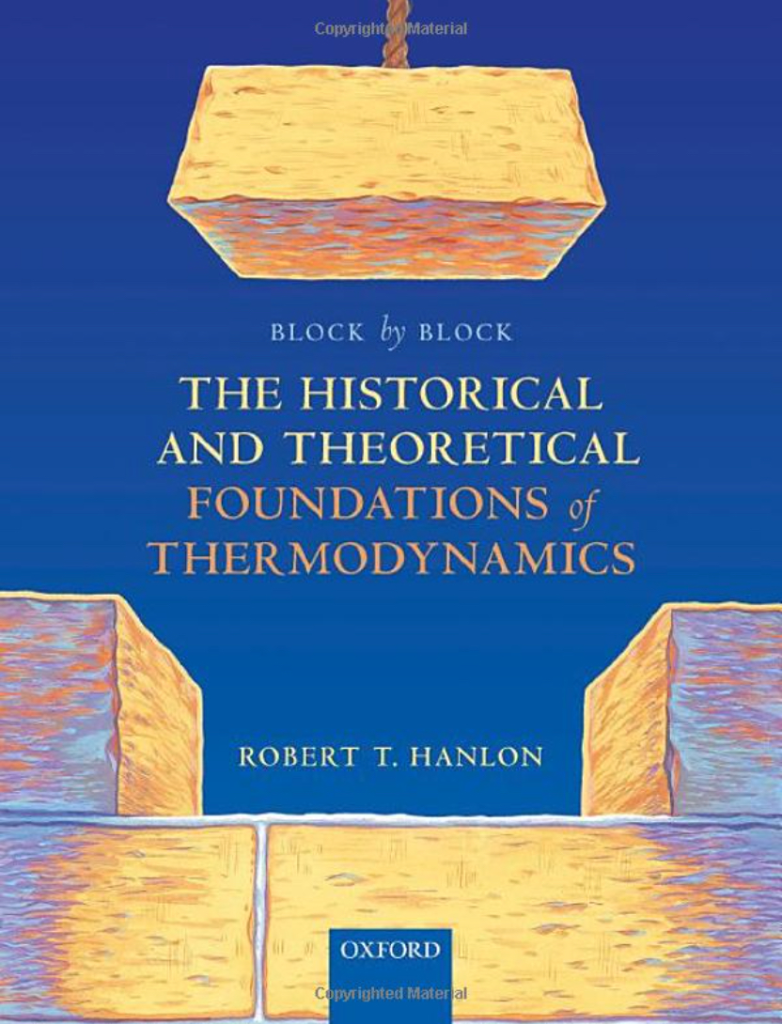
Where were Robert Mayer and Rudolf Clausius in all this? Great question. Learn how their absence turned into a big conflict between P.G. Tait (pro Joule/Thomson) and John Tyndall (pro Mayer/Clausius) in Chapter 33 of my book, Block by Block – The Historical and Theoretical Foundations of Thermodynamics.
References
[1] Cardwell, D. S. L. 1971. From Watt to Clausius; the Rise of Thermodynamics in the Early Industrial Age. Ithaca, N.Y: Cornell University Press, p. 291.
[2] Smith, Crosbie. 1998. The Science of Energy: A Cultural History of Energy Physics in Victorian Britain. Chicago: University of Chicago Press, p. 1.
[3] Thomson initially started with the term “mechanical energy” which was later shortened.
[4] Johann Bernoulli used the term in a letter in 1717 (Chapter 11). Per Harper (Harper, Douglas. 2007. “Energy.” In Online Etymology Dictionary. Archived from the Original on October 11, 2007. Retrieved May 1, 2007.): “ENERGY: From Greek energeia ‘activity, action, operation,’…Used by Aristotle with a sense of ‘actuality, reality, existence’ (opposed to ‘potential’) but this was misunderstood in Late Latin and afterward as ‘force of expression,’ as the power which calls up realistic mental pictures. Broader meaning of ‘power’ in English is first recorded 1660s. Scientific use is from 1807.”
END


Leave a Reply