

We are now entering the final stages of our journey towards the 2nd Law of Thermodynamics, a journey arguably started by Carnot and continued by a host of others, including Émile Clapeyron, James Joule, William Rankine, and William Thomson. In the end, though, it was Rudolf Clausius (1822-1888) who took the final steps.
The power of isolation
I have written about the power of isolation in working out theories in one’s own mind and feel strongly about the benefits of this practice; the isolation enables uninterrupted focus on threads of ideas and the resultant recognition of any elusive connections between them. But it’s also true that for this to work, one must first become fully conversant with the ideas of others. One can really only sit in isolation and let new ideas germinate when one has a starting point consisting of a mixture of others’ ideas. You see this being true when reading the histories of such figures as Newton, Bernoulli, Carnot (here), Clausius, and Gibbs. Each was influenced by others, but each then worked in isolation to create new ideas from these influences. Their ideas didn’t just rise out of nothing.
The solitude of Clausius
Although not much is known about Clausius’ life, it appears that he was indeed one who, being very well read, had many influences, but was also one who worked in solitude. Unfortunately, he left behind hardly any personal correspondences with other scientists and hardly any personal notes other than those found in the margins of the papers and books comprising his library. He left behind no autobiography and provided no content for historians to study. The fact is that we know little of Clausius and his inner thought process, especially as compared against what we know of Thomson’s rather public life inside the highly interactive physics of Scotland. But with this downside came an upside, for it was likely just this solitude that afforded Clausius the opportunity to delve deep into his own thinking, bringing in the ideas of others, yes, but largely doing the final stage of thinking on his own. Perhaps this was how he was able to successfully interpret Carnot and discover entropy, to list just two of his many other vital accomplishments in physics.
Yes, Clausius was pretty much alone and out front in confronting the hidden depths of Carnot. It wasn’t that others weren’t circling around some of the same issues. Rankine and Thomson clearly were and clearly influenced Clausius’ thinking, all three being spurred on by the recent discovery of the conservation of energy. But in the end, it was Clausius alone who arrived at the critical end result.
Clausius may have the dubious distinction of being the most forgotten major nineteenth century scientist – William Cropper [1]
Clausius did not invent entropy. Instead, entropy along with its unique characteristics was sitting there in nature, waiting to be discovered. Across fifteen persistent years, Clausius eventually came upon entropy, took note and brought it to the attention of others. In so doing, he became one of the first theoretical physicists, filling a critical need in those early days of thermodynamics as captured by Klein, who wrote, “What was lacking was not experiment but analysis.”[2] It was analysis that Clausius supplied.
The fact that Clausius’ final publication on Carnot’s work would eventually launch a revolution in the science of chemistry was not immediately apparent. Entropy arrived to little fanfare.
Gibbs to the rescue!
Having said this, Clausius’ discovery did eventually take hold. P.G. Tait, William Thomson, and James Clerk Maxwell all noticed it, although they did not initially do justice to it. But once J. Willard Gibbs and later others, such as Helmholtz, entered the picture, clarity soon arrived. It’s as if Gibbs rescued this burning ember started by Clausius, blew on it, added wood and started a fire. The ember was that close to burning out.
Gibbs relied on the works of both Clausius and Thomson to build his theories. Each offered a different and valuable view of energy. To Thomson, nature dissipates energy such that gradients disappear over time. To Clausius, the disappearance of these gradients results in a quantifiable increase in total entropy. To both, energy remains constant throughout. Gibbs united both views into his own theories. (One could argue that Thomson introduced direction into thermodynamics while Clausius quantified that direction.)
Entropy finds a home in chemistry
Gibbs wouldn’t be alone in finding a powerful use for entropy. Others followed. Recall that one of the most powerful results of Clausius’ discovery was that it united the 1st and 2nd Laws of Thermodynamics into a single equation of state: dU = TdS – PdV. This result unleashed the intellectual might of intellectual giants such as Gibbs, Maxwell and Helmholtz towards the development of a solid theoretical foundation for physical chemistry. While entropy was discovered in the world of physics, it eventually found itself more at home in the world of chemistry.
Gibbs’ famed obituary on Clausius
I should not expect to do justice to the subject, but I might do something – J. Willard Gibbs to J. P. Cooke, 1889, in response to request to write a notice on the work of Clausius [3]
In 1889, Gibbs was asked to write an obituary for Clausius, a man he never met but a man whose footsteps he followed in. Recognizing that this would be a “very delicate matter… [since the]…hot-headed partisans” [4] involved in the infamous Tait-Tyndall disputes [Tait being pro-Joule/British, Tyndall being pro-Mayer&Clausius/German] were still alive, Gibbs bravely accepted the invitation and, understanding that Clausius had been unfairly treated by these “partisans,” set out to right a wrong. That he did. In “one of the most remarkable obituary notices in scientific literature,” [5] Gibbs stood up for Clausius. [6] He praised the “epoch” of Clausius’ First Memoir in 1850 and also his subsequent work on the mechanical theory of heat. Seeking to be just, he also used this opportunity to acknowledge Thomson as an equal contributor, writing, “Clausius was rivaled, perhaps surpassed, in activity and versatility by Sir William Thomson.” [7] But in the end, the obituary was all about Clausius and the primacy of his place in thermodynamics.
Gibbs left no doubt about his opinion in the infamous disputes. He had previously and prominently included Clausius in his own work, by listing entropy in his first paper (1873) as one of the fundamental quantities of thermodynamics alongside energy and then by quoting Clausius’ famous final two sentences as the opening epigraph for his famous third paper on heterogeneous equilibria (1877-8).
Die Energie der Welt ist constant (The energy of the universe is constant)
Die Entropie der Welt strebt einem Maximum zu (The entropy of the universe tends to a maximum)
Gibbs’ alignment with Clausius was furthered revealed by the fact that his epigraph was written in the original language, an act suggesting a need to also re-balance history between Britain and Germany. [8]
The quote I enjoyed the best in Gibbs’ tribute was this. Gibbs made reference to a statement Henri Victor Regnault once made about the fact that he was developing experimental data to help answer the question, which I paraphrase here, how much work can be generated from a given quantity of heat? Gibbs cites the work done by Helmholtz, Joule, William and James Thomson and Rankine in addressing this question and then wrote, referring to the time period of confusion prior to Clausius’ groundbreaking 1850 First Memoir, “Truth and error were in a confusing state of mixture. Neither in France, nor in Germany, nor in Great Britain, can we find the answer to the question quoted from Regnault. The case was worse than this, for wrong answers were confidently urged by the highest authorities. [emphasis added] That question was completely answered, on its theoretical side, in the memoir of Clausius, and the science of thermodynamics came into existence.” [9] It doesn’t get much better than that.
Learn how Clausius discovered entropy!!!
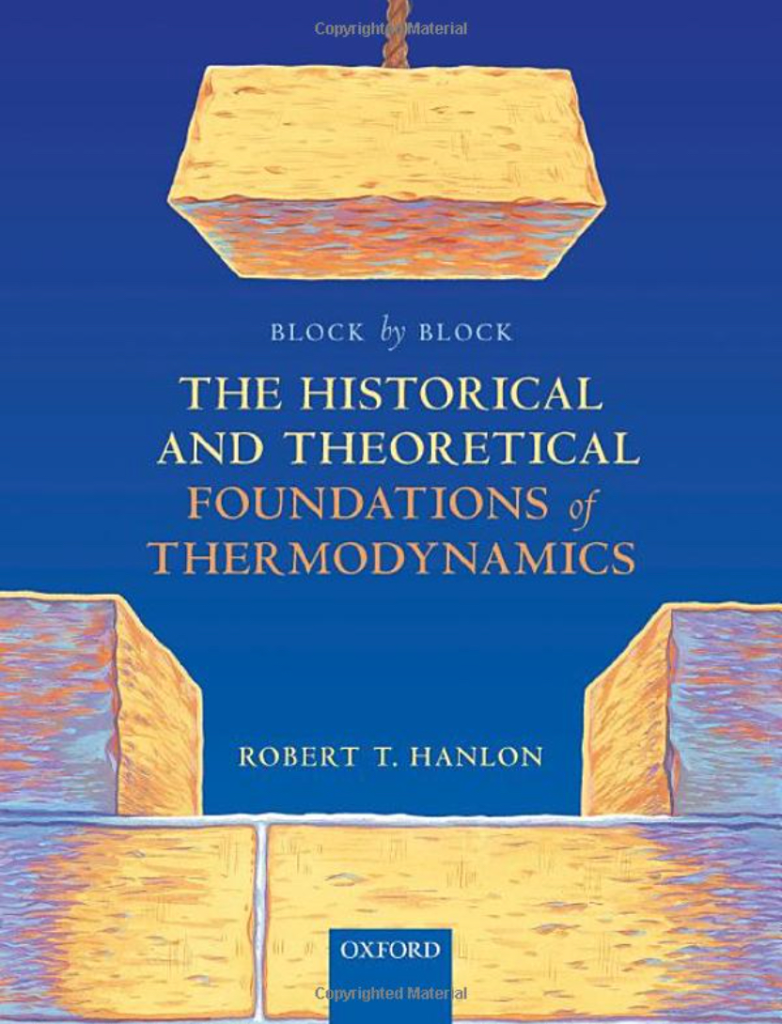
Follow Clausius’s train of thought, logic, and equations as he discovered entropy in Chapter 34 of my book, Block by Block – The Historical and Theoretical Foundations of Thermodynamics.
References
[1] Cropper, William H. 1986. “Rudolf Clausius and the Road to Entropy.” Am. J. Phys. 54 (12) (December), p. 1073.
[2] Klein, Martin J., 1969, “Gibbs on Clausius.” Historical Studies in the Physical Sciences (University of California Press) 1: 127–49, p. 131.
[3] Gibbs quote cited in Rukeyser, Muriel. 1988. Willard Gibbs. Woodbridge, Conn: Ox Bow Press, p. 300.
[4] Klein, p. 128.
[5] Quote from J. G. Crowther (1937) in Klein, p. 129.
[6] Gibbs, J. Willard. 1889. “Rudolf Julius Emanuel Clausius.” Proceedings of the American Academy of Arts and Sciences 24: 458–65.
[7] Gibbs, p. 460.
[8] Klein, p. 134.
[9] Gibbs, p. 459.
END


Leave a Reply