
joule
-
Physical chemistry – a new field in science
As a young man I tried to read thermodynamics, but I always came up against entropy as a brick wall that stopped any further progress. – James Swinburne (1904) [1] The second law of thermodynamics, which is known also as the law of the dissipation or degradation of energy, or the law of the increase… Continue reading
-
The Unsung Legacy of Rudolf Clausius

We are now entering the final stages of our journey towards the 2nd Law of Thermodynamics, a journey arguably started by Carnot and continued by a host of others, including Émile Clapeyron, James Joule, William Rankine, and William Thomson. In the end, though, it was Rudolf Clausius (1822-1888) who took the final steps. The power… Continue reading
-
For every effect, there must be a cause
The 1st Law of Thermodynamics is all about energy and its conservation. In 1850 Rudolf Clausius put it into an equation by conducting an energy balance around the working substance inside a piston. ∆U = Q - W The change in internal energy of a system (U) is equal to the heat (Q) entering the system minus the work (… Continue reading
-
Fourier solved heat. Or did he?

Thermodynamics began when caloric ended A pivotal event in thermodynamic history occurred when Julius Robert Mayer and James Joule independently overthrew the caloric theory of heat, revealing heat and work as two forms of energy. In 1850 Rudolf Clausius used these findings to correct the single flaw in Sadi Carnot’s 1824 theoretical analysis of the… Continue reading
-
Why I paid $100 for a Vonnegut quote

Publisher: “Before we go to print, we just wanted to make sure you got permissions for the epigraphs in your book.” Me: “What’s an epigraph?” As I was traveling through the final stages of publishing my book, I learned that there are two approaches to using a quote. One is to embed the quote in… Continue reading
-
Joule-Thomson Effect (Part 2) – my hypothesis
In a previous video (here), I stated my belief that a better understanding of thermodynamics is available by identifying the connections between the micro-world of moving and interacting atoms and the macro-world of classical thermodynamics. My goal is to do just this. My starting point? The Joule-Thomson effect, which is the temperature change that occurs… Continue reading
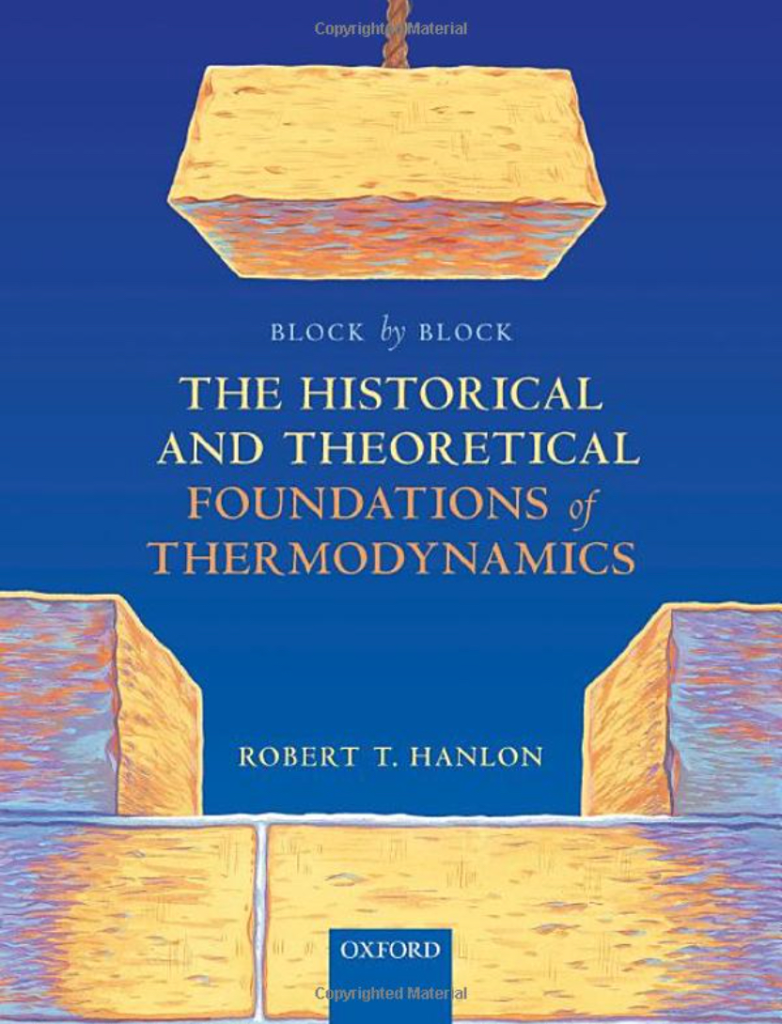
Block by Block – The Historical and Theoretical Foundations of Thermodynamics. “Hanlon has written a masterpiece.” – Mike Pauken, Senior Engineer, NASA’s Jet Propulsion Laboratory (JPL) and author of Thermodynamics for Dummies
SUBSCRIBE
About Me

Hi! I’m Bob Hanlon. After earning my Sc.D. in chemical engineering from the Massachusetts Institute of Technology and enjoying a long career in both industry and academia, I’ve returned to school, my own self-guided school, seeking to better understand the world of thermodynamics. Please join me on my journey.
You must be logged in to post a comment.