
entropy
-
Problem Solving – illustrated

The Chemical Engineering Department at MIT developed a two-week preparatory course for Practice School students, focusing on essential skills such as project management, time management, safety, professional behavior, career development, and problem solving. Among these, the problem-solving module is considered one of the most important for successfully completing the one-month Practice School projects. You make… Continue reading
-
Dissemination of Gibbs’s work (Path 2): Gibbs ➔ van der Waals ➔ Roozeboom ➔ community
In my previous two posts (here and here), I described the ways by which J. Willard Gibbs’s work on thermodynamics spread through the European science community. In this post I describe another way Gibbs’s work spread and it began with early admirer of Gibbs, Johannes Diderik van der Waals (1837-1923), a Dutch theoretical physicist. It… Continue reading
-
Dissemination of Gibbs’s work (Path 1): Gibbs ➔ Maxwell ➔ Pupin ➔ Helmholtz ➔ van’t Hoff ➔ community
Gibbs’ work spread throughout Europe along two separate paths. As already mentioned (here), the first started with Maxwell. It was his book that indirectly led Gibbs’s work to Helmholtz along an interesting path taken by Michael Pupin (1858-1935).[1] As a doctoral student in experimental physics at the University of Berlin under Helmholtz, Pupin was familiar… Continue reading
-
How Gibbs’s work spread into the science community

It is a great pity that many cultivators of the science of thermodynamics since the time of Gibbs have not gone back to the fountainhead and closely correlated their results with this. – F. G. Donnan [1] The exceptional man is always in advance of his generation. Willard Gibbs was not alone in failing at… Continue reading
-
Why Gibbs’s maximum work equation continues to fascinate me

Classical thermodynamics doesn’t prescribe how to design a process but does set boundaries on what the process can achieve. These boundaries quantify either the maximum work generated by or the minimum work required for the process. The calculations behind these boundaries are invaluable for assessing the economic feasibility and practical potential of ideas. Gibbs helped… Continue reading
-
Gibbs’s 3rd Paper – not for the faint of heart!

[Gibbs’ “Equilibrium of Heterogeneous Substances”] is unquestionably among the greatest and most enduring monuments of the wonderful scientific activity of the nineteenth century. – H. A. Bumstead [1] Like Sir Isaac Newton’s Principia, this work of Willard Gibbs stands out in the history of man’s intellectual progress as an imperishable monument to the power of… Continue reading
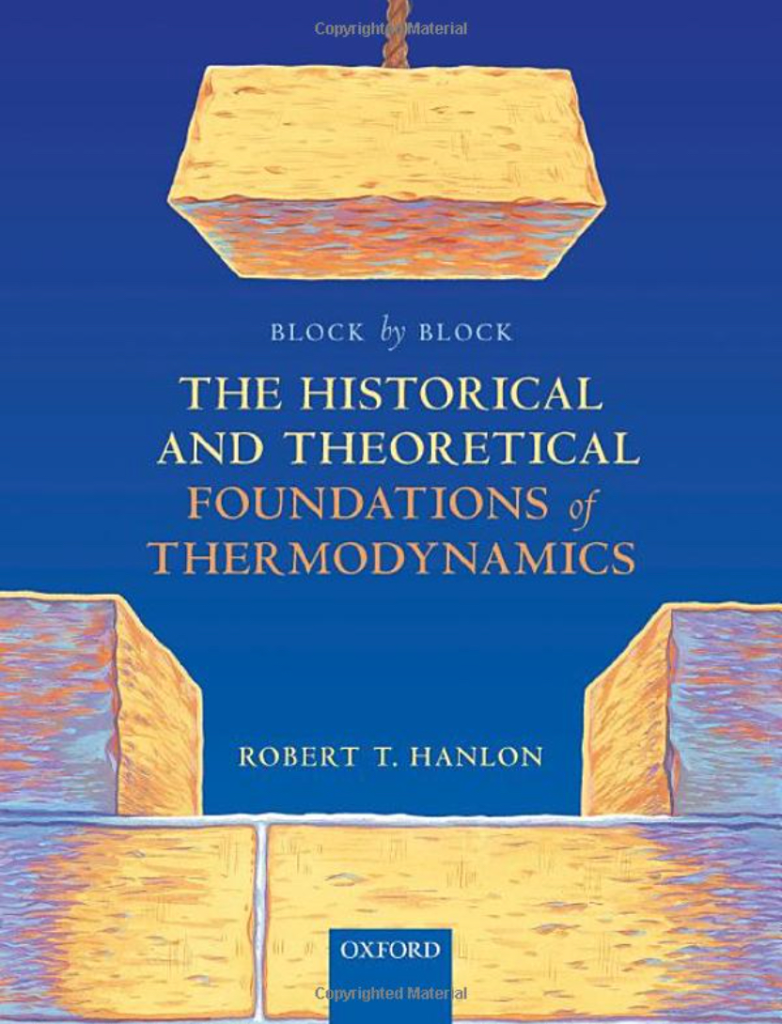
Block by Block – The Historical and Theoretical Foundations of Thermodynamics. “Hanlon has written a masterpiece.” – Mike Pauken, Senior Engineer, NASA’s Jet Propulsion Laboratory (JPL) and author of Thermodynamics for Dummies
SUBSCRIBE
About Me

Hi! I’m Bob Hanlon. After earning my Sc.D. in chemical engineering from the Massachusetts Institute of Technology and enjoying a long career in both industry and academia, I’ve returned to school, my own self-guided school, seeking to better understand the world of thermodynamics. Please join me on my journey.
You must be logged in to post a comment.