
electrochemical cell
-
Why Gibbs’s maximum work equation continues to fascinate me

Classical thermodynamics doesn’t prescribe how to design a process but does set boundaries on what the process can achieve. These boundaries quantify either the maximum work generated by or the minimum work required for the process. The calculations behind these boundaries are invaluable for assessing the economic feasibility and practical potential of ideas. Gibbs helped… Continue reading
-
Deciphering the physical meaning of Gibbs’s maximum work equation

I am very pleased that Foundations of Chemistry supported publication of my paper (link below followed by abstract) that concluded with a question rather than a conclusion! As I am in search of the answer, please let me know if you know someone, likely a physical chemist, who has it. https://link.springer.com/article/10.1007/s10698-024-09503-3 Abstract J. Willard Gibbs… Continue reading
-
Riddle me this: what is the physical significance of T∆S in Gibbs’ maximum work equation?

Remember this? Maximum work = -∆Grxn = -(∆Hrxn – T∆Srxn) At some point toward the end of undergraduate thermodynamics, we were taught this equation. Unfortunately, most of us, myself included, graduated without actually understanding it. Why? You already know the answer, just by looking at it. Because entropy is involved. While many have a reasonable… Continue reading
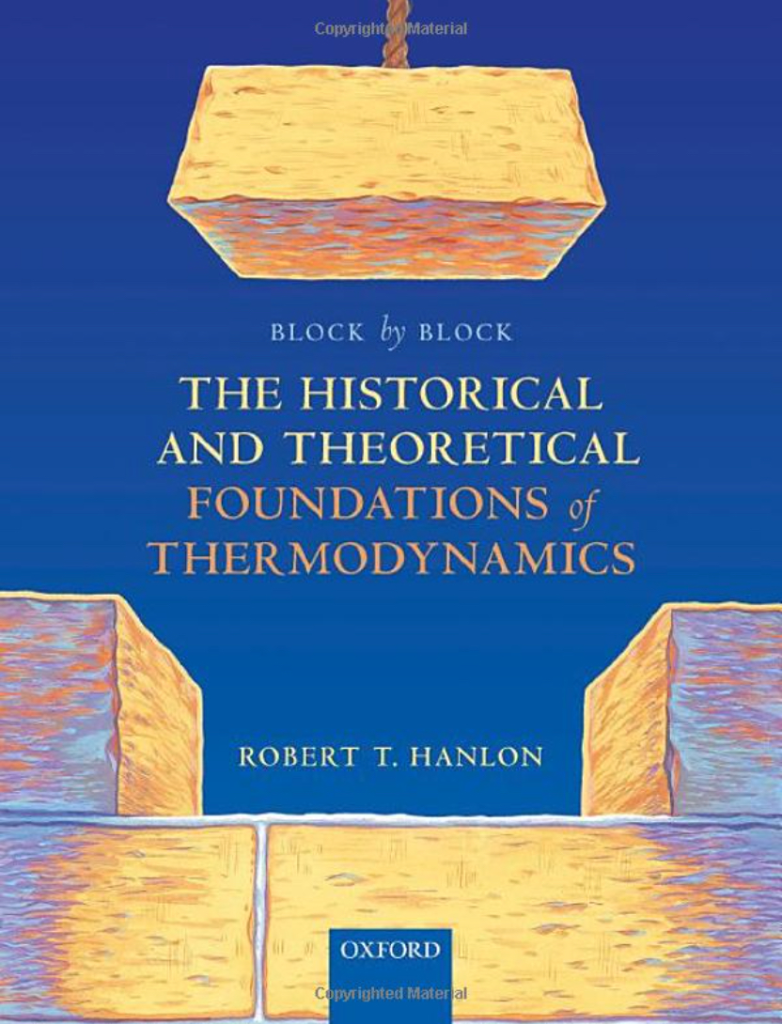
Block by Block – The Historical and Theoretical Foundations of Thermodynamics. “Hanlon has written a masterpiece.” – Mike Pauken, Senior Engineer, NASA’s Jet Propulsion Laboratory (JPL) and author of Thermodynamics for Dummies
SUBSCRIBE
About Me

Hi! I’m Bob Hanlon. After earning my Sc.D. in chemical engineering from the Massachusetts Institute of Technology and enjoying a long career in both industry and academia, I’ve returned to school, my own self-guided school, seeking to better understand the world of thermodynamics. Please join me on my journey.
You must be logged in to post a comment.