
laws of motion
-
Newton: the apple, the moon, and universal gravitation

Did you know the moon is in constant freefall towards Earth? Here’s how Sir Isaac Newton figured this out and discovered Universal Gravitation in the process. The apple’s role Action-at-a-distance. His contemporaries thought it impossible. Not so Newton. He embraced the concept. The falling apple, the orbiting moon, perhaps governed by the same, unseen force? … Continue reading
-
To appreciate Galileo, you need to first understand Aristotle
While several huge ah-ha moments occurred during completion of the Big Bang and the atom puzzles, the discovery of energy and its conservation was not as clean-cut. The Big Bang was an event, the atom an object, and each was a product of nature. Each leant itself to true discovery. But energy was different. It… Continue reading
-
Newton: On whose shoulders did he stand?
No Newton, no Principia. That much is clear. But did Newton do it alone? He was naturally exposed to the ideas of such predecessors as Descartes and Galileo and such contemporaries as Leibniz and Huygens. That this collective influenced Newton is reflected in his own writing, “If I have seen further it is by standing… Continue reading
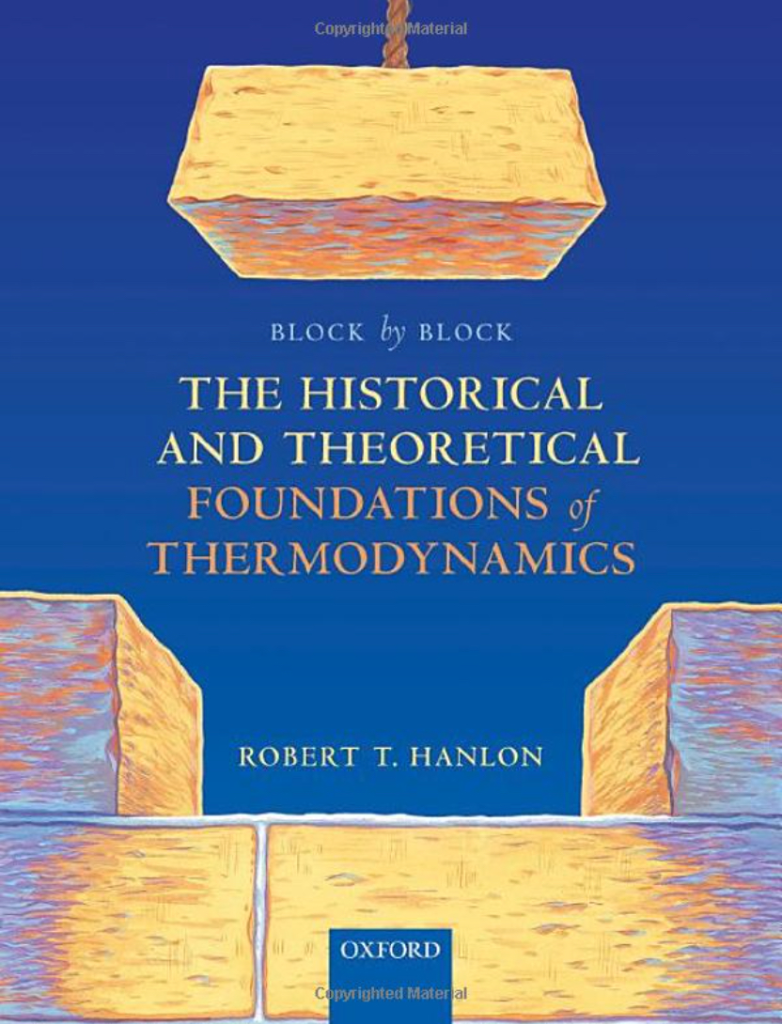
Block by Block – The Historical and Theoretical Foundations of Thermodynamics. “Hanlon has written a masterpiece.” – Mike Pauken, Senior Engineer, NASA’s Jet Propulsion Laboratory (JPL) and author of Thermodynamics for Dummies
SUBSCRIBE
About Me

Hi! I’m Bob Hanlon. After earning my Sc.D. in chemical engineering from the Massachusetts Institute of Technology and enjoying a long career in both industry and academia, I’ve returned to school, my own self-guided school, seeking to better understand the world of thermodynamics. Please join me on my journey.
You must be logged in to post a comment.